Business
Online Marketing Budget Calculator: How Much Should You Spend on Marketing in 2026?
How to work out a digital marketing budget in 2026: percentage of revenue by industry and stage, a bottom-up check from your lead goal, a channel split, and worked INR and USD examples.
11 min readNew
An online marketing budget calculator turns three inputs (revenue, industry and growth stage) into a monthly spend you can defend. Most small businesses land between 5% and 10% of revenue, and large firms averaged 7.7% in Gartner's 2025 CMO Spend Survey. Then check that figure bottom-up: the leads you need multiplied by what each lead costs.
I set budgets this way before we touch any client's ad account, because a number that only works one way usually breaks within a quarter. Below: both methods, the benchmarks worth trusting, two worked examples and the mistakes a calculator can't catch.
How does an online marketing budget calculator work?
Every online marketing budget calculator uses one of two methods, and the useful ones show you both.
Top-down (percentage of revenue). You pick a share of annual revenue based on your industry and stage, then divide by 12.
Monthly marketing budget = annual revenue × marketing % ÷ 12
Bottom-up (goal-based). You start from the revenue you want, work out how many customers and leads that takes, and multiply by what a lead costs.
Budget = (revenue goal ÷ average sale ÷ close rate) × cost per lead
Our free marketing budget calculator does the top-down part: enter revenue, business type and stage, and it recommends a percentage, a monthly figure and a channel split. The lead funnel calculator does the bottom-up part, starting from a monthly revenue goal and working back to the visitors, leads and ad budget you need.
If the two answers are within about 20% of each other, you have a budget. If they're far apart, one assumption is wrong, and finding it is the most valuable ten minutes of the exercise.
What percentage of revenue should you spend on marketing?
There is no single right percentage, but there are good reference points. The two biggest annual surveys disagree slightly because they ask different companies.
| Source (year) | Who was surveyed | Marketing budget as % of revenue |
|---|---|---|
| Gartner CMO Spend Survey (2025) | 402 marketing leaders in North America, the UK and Europe, mostly large firms | 7.7% average, flat on 2024; half reported 6% or less |
| The CMO Survey, Spring 2025 (Duke Fuqua, Deloitte, AMA) | 281 marketing leaders at US for-profit companies | 9.4%, up from 7.7% in Spring 2024 |
| Gartner (2025), IT and business services | Subset of the survey above | 5.8%, down from 9% in 2024 |
Two quotable takeaways:
- Marketing budgets averaged 7.7% of company revenue in Gartner's 2025 CMO Spend Survey, and 59% of those CMOs said it wasn't enough to execute their strategy.
- The CMO Survey (Spring 2025) put US marketing spend at 9.4% of company revenue, up from 7.7% a year earlier.
You'll also see "spend 7–8% of revenue on marketing" quoted all over the web as US Small Business Administration advice, usually for firms under $5 million in revenue with 10–12% margins. I couldn't find that wording on sba.gov itself, so treat it as a rule of thumb rather than official guidance.
These are averages for established companies. A small business picks its own number by industry and stage, which is what the calculator does with these planning ranges:
| Business type | Typical range (% of revenue) | Launch | Grow | Maintain |
|---|---|---|---|---|
| Salon or spa | 5–10% | 10% | 7.5% | 5% |
| Clinic or chiropractic | 5–10% | 10% | 7.5% | 5% |
| Local services (trades, repairs, coaching) | 5–10% | 10% | 7.5% | 5% |
| Real estate | 6–12% | 12% | 9% | 6% |
| Law firm | 5–12% | 12% | 8.5% | 5% |
| Consulting and B2B services | 3–8% | 8% | 5.5% | 3% |
| Online store | 8–15% | 15% | 11.5% | 8% |
| SaaS | 10–25% | 25% | 17.5% | 10% |
Treat these as starting benchmarks, not rules. Once campaigns run, your own cost per customer replaces every number in this table.
Why does your growth stage change the number?
Stage matters as much as industry, because it changes how much of your demand marketing has to create.
- Launch. Nobody knows you, you have no reviews, rankings or referrals, so paid channels carry everything. Budget at the top of your range for roughly the first year.
- Grow. You know a few channels work and you're scaling them. The middle of the range funds steady acquisition while you test one or two new channels.
- Maintain. SEO, reviews, repeat customers and email bring in a large share of work. The low end usually holds your position, with paid spend kept lean.
The trap I see most often: an eight-year-old business budgeting like a launch-stage one because a competitor is loud on Instagram. A rival's visible spend tells you nothing about their margins or what converts.
How do you check the budget bottom-up from a lead goal?
The bottom-up check is where the budget either holds or falls apart. You need four numbers:
- Revenue goal for new business per month.
- Average sale or customer value (first-year value for repeat businesses).
- Close rate from lead to paying customer.
- Cost per lead (CPL), from your own ad accounts if you have them.
If you don't have a CPL yet, use public benchmarks as a placeholder. Across Google Ads, WordStream's 2025 benchmarks put the average cost per click at $5.26 and the average cost per lead at $70.11, mostly from US accounts. Indian CPCs and CPLs are usually far lower than these US-weighted averages, but they vary enormously by city and category, so run a two-to-four week test and replace the placeholder with your real number.
Then work through it: customers needed = goal ÷ average sale; leads needed = customers ÷ close rate; ad budget = leads × CPL. The lead funnel calculator does exactly this and also shows the website traffic you'd need. If the budget looks impossible, the cheapest fix is rarely more traffic. It's usually a better landing page or faster follow-up, which is why I'd run a free website audit before raising ad spend.
Worked examples: an Indian SMB and a US or UK small business
Here are two businesses run through both methods. The CPL and close rates are example assumptions to show the maths, not benchmarks.
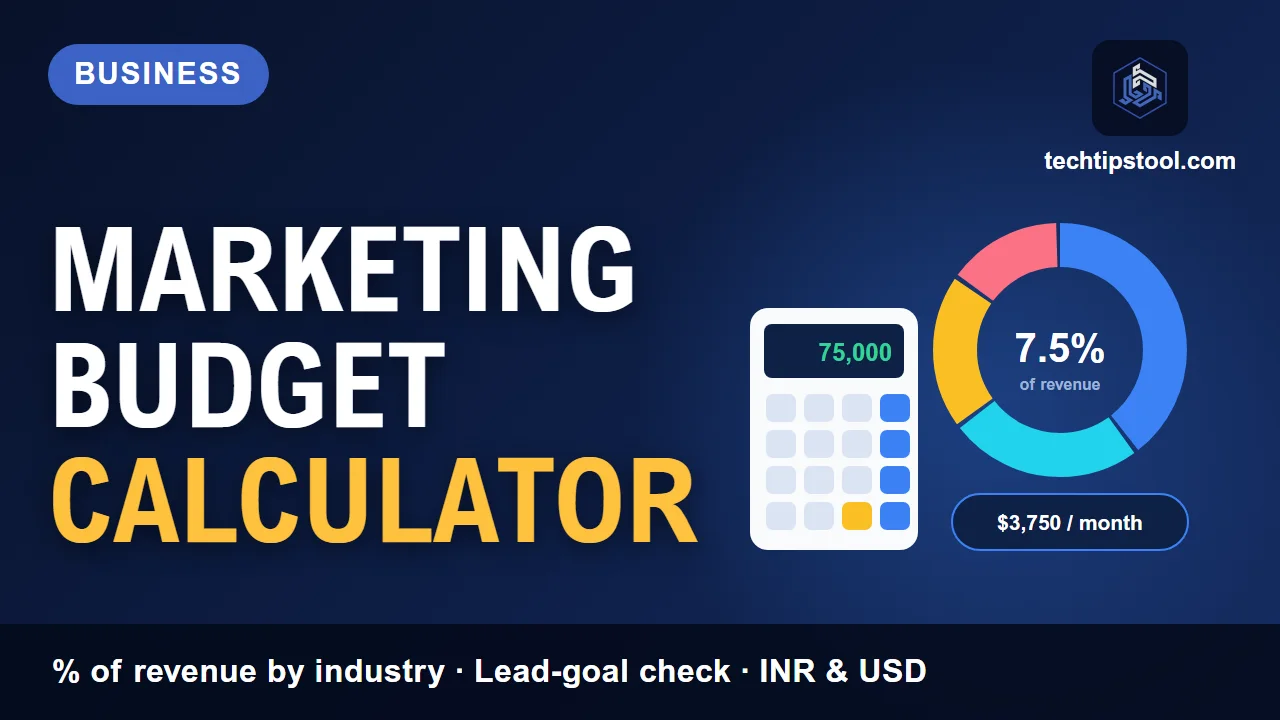
Example A: a dental clinic in Delhi NCR, growing stage. Annual revenue ₹1.2 crore. Clinics sit at 5–10%, so the grow-stage midpoint is 7.5%: ₹9,00,000 a year, or ₹75,000 a month.
Bottom-up: the clinic wants ₹3,00,000 of new-patient revenue a month. At ₹15,000 average first-year value per patient, that's 20 new patients. With a 40% lead-to-patient rate, it needs 50 leads. At an example CPL of ₹600, that's ₹30,000 of ad spend, leaving ₹45,000 for local SEO, Google Business Profile, content and review generation.
Example B: a US home-services company, growing stage. Annual revenue $600,000. Local services sit at 5–10%, so 7.5% gives $45,000 a year, or $3,750 a month.
Bottom-up: the owner wants 25 new jobs a month. With a 35% lead-to-job rate, that's about 72 leads. At an example CPL of $50, ad spend is $3,600 a month, nearly the whole budget. The UK version works the same way in pounds; only the CPL changes.
| Dental clinic, Delhi NCR | Home services, US | |
|---|---|---|
| Annual revenue | ₹1,20,00,000 | $600,000 |
| % of revenue (grow stage) | 7.5% | 7.5% |
| Top-down monthly budget | ₹75,000 | $3,750 |
| New customers needed per month | 20 | 25 |
| Leads needed (at close rate) | 50 (40%) | 72 (35%) |
| Example cost per lead | ₹600 | $50 |
| Bottom-up ad spend | ₹30,000 | $3,600 |
| Verdict | Budget covers ads plus SEO and content | Budget is almost all ads; SEO must wait or revenue goal drops |
The US example is the more useful one. When bottom-up ad spend eats the whole budget, you can accept a smaller goal, raise the percentage for a fixed period, or improve conversion so each lead costs less.
How should you split the budget across channels?
Large companies spend heavily on paid media. Gartner's 2025 survey found paid media took 30.6% of marketing budgets (about 2.4% of company revenue), and a June 2025 Gartner release found digital channels made up 61.1% of total marketing spend, with paid search the largest digital channel at 13.9% of digital spend.
Small businesses should split by where their buyers are already looking:
- Local businesses (clinics, salons, trades): Google Business Profile and local SEO first, then Google Search ads for high-intent terms, then Meta for offers and retargeting.
- B2B services and SaaS: search ads and content for existing demand, LinkedIn for reaching named job titles, email for nurturing long sales cycles.
- Online stores: Meta and Google Shopping for acquisition, email and WhatsApp for repeat purchases.
A simple rule I use for the paid portion: put about 70% into channels with proven cost per customer, 20% into the most promising next channel, and 10% into experiments. Our ad budget planner lets you drag that split across Google, Meta, YouTube and LinkedIn and see the clicks, leads, CPL and customer acquisition cost (CAC) for each.
What I would not recommend: spreading a ₹50,000 or $1,000 monthly budget across five channels. Each one gets too little spend to produce clean data, and you end up cutting everything after two months. Two channels done properly beat five done thinly.
What else belongs in a digital marketing budget besides ad spend?
Make sure the total covers everything, not just media:
- Ad spend, paid to Google, Meta, LinkedIn and others.
- Tax on ad spend. Indian advertisers pay 18% GST on platform invoices (LinkedIn documents this on its billing help pages). Budget for it unless you can claim input tax credit.
- People or agency fees, in-house, freelance or retainer.
- Content, creative and tools: photos, video, posts, CRM, email platform.
- Website improvements, because conversion rate sets your real CPL.
On agency fees, I'll be direct about our own pricing. TechTipsTool's paid ads management runs from ₹60,000 ($1,050) to ₹1,65,000 ($2,900) a month, with ad spend paid separately to the platforms. If your entire marketing budget is ₹75,000 a month, I would not recommend spending most of it on our retainer; put it into media and a one-time setup instead, and use the plan finder to see which package fits a smaller budget. Every current price is on the pricing page.
What mistakes won't a marketing budget calculator catch?
A calculator does arithmetic. It can't see these, so check them yourself:
- Copying enterprise benchmarks. Gartner's figures come mostly from large companies. A 7.7% average says little about a two-location salon.
- Budgeting before tracking. Without conversion tracking and UTM-tagged links, you can't calculate CPL, so you can't improve the budget.
- Judging in week three. Most paid channels need four to eight weeks of steady spend before cost per lead settles.
- Ignoring gross margin. A 10% marketing budget is fine at 60% margins and painful at 15%.
- Treating the number as fixed. The first budget is a hypothesis; your data replaces it.
Use this checklist before you sign off a budget:
- I've run the top-down calculation using my real annual revenue (or a conservative forecast)
- I've run the bottom-up calculation from a monthly revenue goal
- The two answers are within about 20%, or I know which assumption explains the gap
- Conversion tracking and UTM tags are live, so I can measure cost per lead
- The budget includes GST or VAT, fees, content and tools, not just media
- Paid spend is concentrated on no more than two or three channels
- I've set a review date four to eight weeks after launch
How often should you revisit your marketing budget?
Review on three rhythms:
- Monthly: check CPL and CAC by channel against the assumptions you budgeted with. Move money between campaigns, not between strategies.
- Quarterly: rerun the online marketing budget calculator with updated revenue, shift budget toward the channels with the lowest cost per customer, and retire anything that hasn't paid back.
- Yearly: reset the percentage for your new stage. A business moving from launch to grow should usually see its percentage fall even as the rupee or dollar amount rises.
To see what each budget level buys from an agency, our digital marketing packages guide breaks down deliverables by tier.
The bottom line
Pick a percentage with the calculator, prove it bottom-up against a real lead goal, and spend it on two or three channels you can measure. Start with the free marketing budget calculator, then book a free website audit so your budget isn't leaking through a page that doesn't convert.
FAQ
What is a good marketing budget for a small business?
Most small businesses spend between 5% and 10% of annual revenue on marketing, with launch-stage businesses at the top of that range. B2B consultancies often spend less (3–8%) and online stores and SaaS companies more. Check your figure bottom-up from the number of leads you need before committing.
Is 10% of revenue too much to spend on marketing?
Not necessarily. Ten percent is normal for a new business, a growing online store or a clinic in a competitive city, and SaaS companies often spend far more. It's too much only if your gross margin can't absorb it or your cost per customer is higher than a customer is worth.
How much should a startup with no revenue spend on marketing?
Use a revenue target instead of actual revenue, and budget from the bottom up: how many customers you need, how many leads that takes, and what a lead costs. Set a fixed test budget for 60–90 days, measure cost per lead, then scale only the channels that pay back.
Does a marketing budget include salaries and agency fees?
It should. A complete budget covers ad spend, taxes on ad spend, people or agency fees, content, tools and website improvements. Budgets that count only media spend look affordable on paper and then run out mid-quarter.
How accurate is an online marketing budget calculator?
It's accurate as a starting point and wrong as a final answer. Percentage-of-revenue ranges come from industry averages, so the real test is your own cost per lead and cost per customer after four to eight weeks of spend. Rerun the calculation every quarter with your actual numbers.